
If you are searching how to buy a franchise with no money, here is the honest answer up front: you almost certainly cannot buy one with nothing at all. Every route into franchise ownership asks for some money of your own, at some point, from somewhere. What you can do is lower how much cash you need, change where it comes from, and avoid the offers that promise zero and cost you more later.
This guide walks through why “no money down” rarely holds up, what lenders and franchisors actually require, and the realistic ways people with limited savings get into a franchise.
Why “no money down” franchises are rare
A franchise is a business with real start-up costs: the franchise fee, build-out or equipment, opening inventory, and the working capital to keep going until the business pays you. Someone has to fund all of that. If you are not putting money in, a lender or the franchisor is taking all of the risk, and neither has much reason to do that for a buyer with nothing at stake.
That is also why franchisors screen for capital before they screen for anything else. Most set a minimum net worth and a minimum amount of liquid cash in their application, and some set the bar high. McDonald’s, for example, says it generally requires $500,000 of non-borrowed personal resources just to be considered. Lower-cost concepts ask for far less, but very few ask for nothing.
Treat any “no money needed” franchise pitch with caution. The cost has usually moved somewhere you have not looked yet: a high-interest loan, a large ongoing fee, or an arrangement where you are buying a job rather than a business.
What an SBA lender expects you to bring
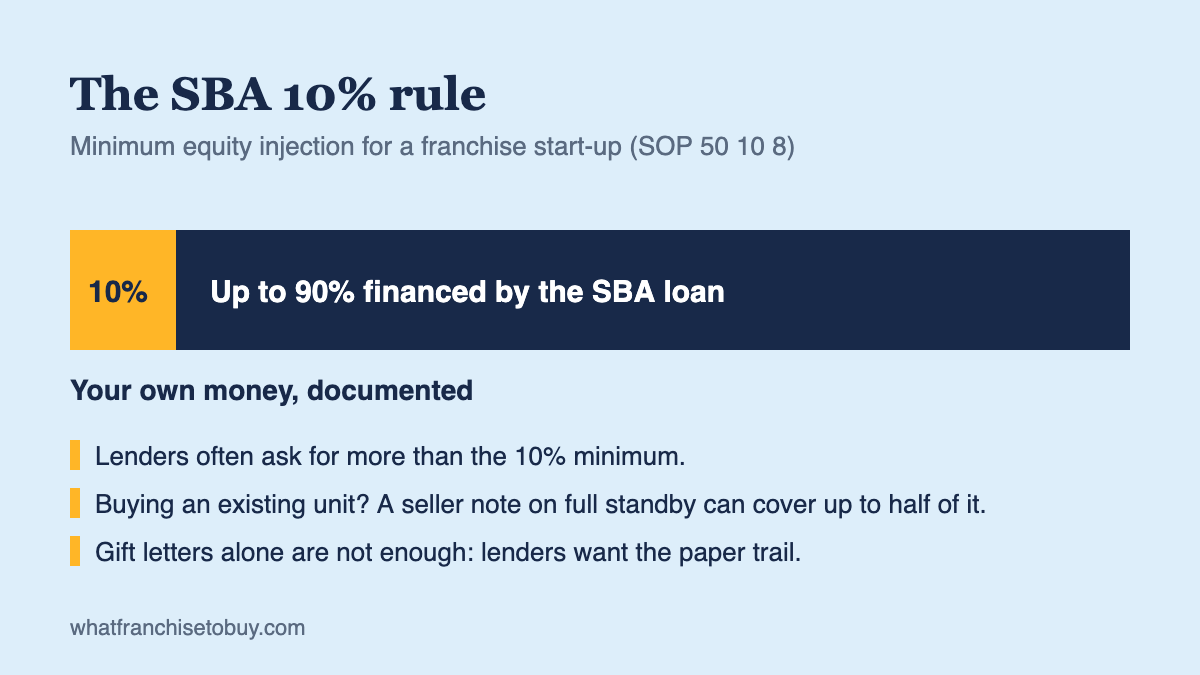
SBA loans are the most common way franchise buyers borrow, and they come with a clear rule. Under the SBA’s current lending rules (SOP 50 10 8, effective June 1, 2025), a start-up or a complete change of ownership generally needs a minimum equity injection of 10% of total project cost. That is the floor. Many lenders ask for more, depending on your credit, experience and the concept.
Two details matter for buyers with limited cash. First, the injection has to be real and documented: lenders want bank statements and a clear trail, not just a letter. Second, when you buy an existing franchise from a seller, a seller note can cover part of the injection, but only up to half of it and only if the note sits on full standby for the life of the SBA loan. Our guide to SBA loans for franchise buyers covers the process step by step, and you can check whether a brand is eligible in the SBA Franchise Directory.
A worked example: what “no money” really means in dollars
Numbers make this clearer. The figures below are made up for illustration, not taken from any brand, so swap in the totals from the FDDs you are actually reading.
Say the total project cost for a franchise you like comes to $150,000. Under the 10% minimum, you would need at least $15,000 of your own documented money. If you were buying an existing location and the seller agreed to a note on full standby, that note could cover up to half of the injection, or $7,500, leaving at least $7,500 from you. A lender may still ask for more than the minimum.
Then add the money you live on. If your household spends $6,000 a month and you want six months of cushion while the business ramps up, that is another $36,000 you need available outside the deal. In this example, even the leanest version of trying to buy a franchise with no money still calls for tens of thousands of dollars you can reach. That is why the real question is not whether you can put in zero, but how to make a smaller number work.
How to buy a franchise with no money: the realistic routes
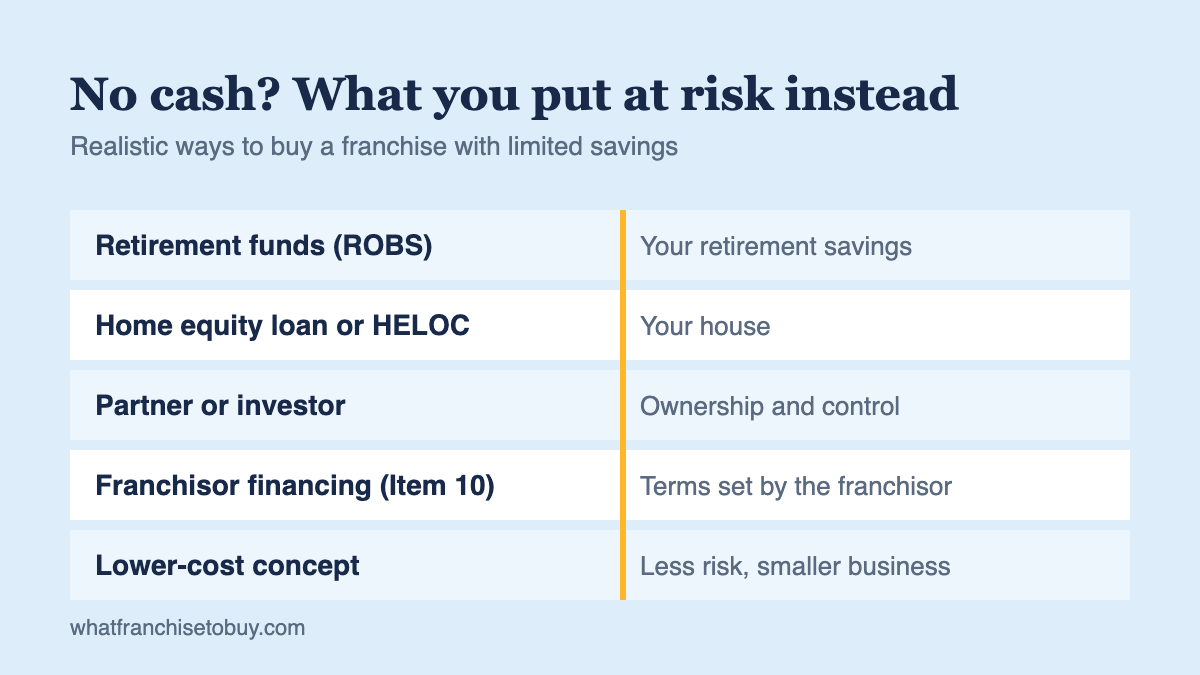
None of these is free money. Each one replaces cash in the bank with something else you put on the line. That trade can make sense, but it should be a choice you make with your eyes open.
- Your retirement savings, through ROBS. A Rollover as Business Start-up lets you move eligible retirement funds into a new C corporation that owns the business, without an early-withdrawal tax. The IRS does not treat ROBS as an abusive arrangement in itself, but its ROBS compliance project found many plans that missed required filings, and many businesses that failed and took the owner’s retirement savings with them. It is “no money” only in the sense that the money is not in your checking account. See using a 401k to buy a franchise for how it works.
- Home equity. A home equity loan or line of credit can fund your injection, but it puts your house behind the business. Lenders will look at it closely, and you should too.
- A partner or investor. Someone else puts in capital in exchange for a share of the business. This can work well, but agree in writing on who runs it, how profits are split, and what happens if one of you wants out, before you sign anything with a franchisor.
- Franchisor financing. Some franchisors finance part of the franchise fee or equipment, or have relationships with lenders. Whatever they offer has to be described in Item 10 of the FDD, so read that section before you count on it.
- Veteran incentives. Many franchisors reduce the franchise fee for veterans. It lowers the amount you need, though it rarely covers the full investment. Our guide to franchises for veterans covers how these programs work.
- A lower-cost concept. Home-based and mobile franchises often need far less capital than a storefront or restaurant. Starting smaller is often the most realistic answer to limited savings. See low-cost franchise opportunities for what to look for under $100K.
Red flags in “no money down” franchise offers
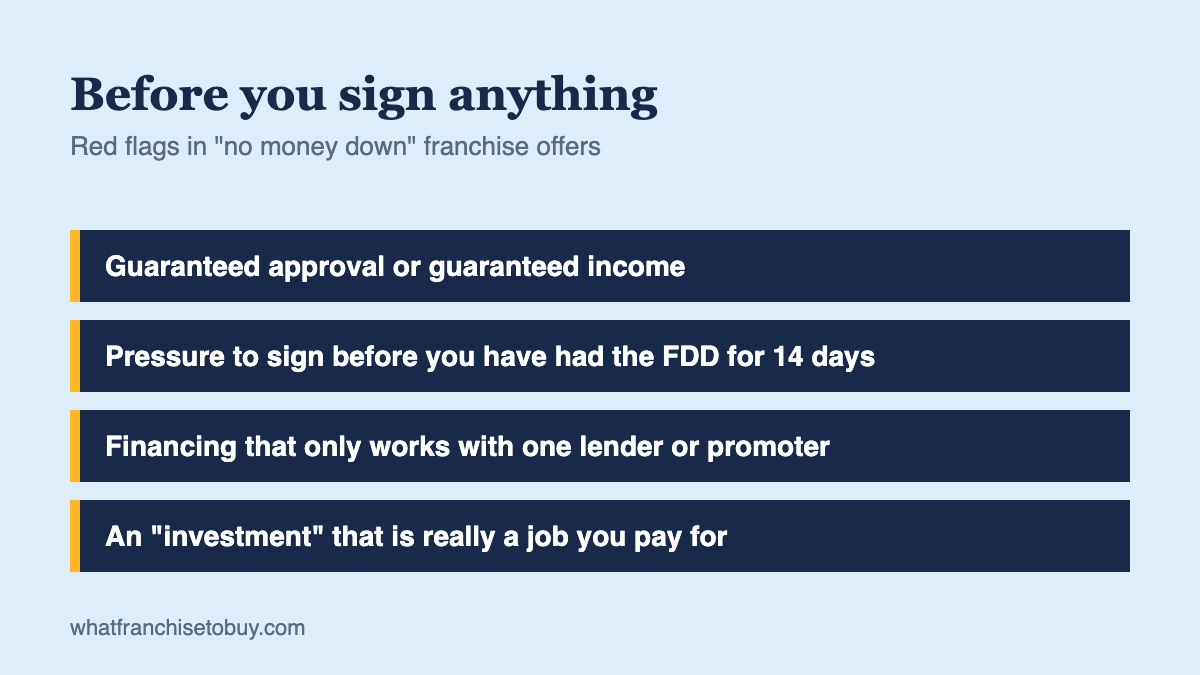
Most people trying to buy a franchise with no money are not hurt by the honest routes above. They are hurt by offers built to look effortless. A few patterns are worth walking away from:
- Guaranteed approval or guaranteed income. No lender or franchisor can promise either. Any income figure a franchisor gives you has to come from Item 19 of the FDD, and if a brand has no Item 19, nobody representing it should be quoting you earnings.
- Pressure to sign before you have the FDD. A franchisor must give you the FDD at least 14 calendar days before you sign a binding agreement or pay any money. Anyone rushing you past that is a reason to slow down.
- Financing that only works with one specific lender or promoter. Compare it with a standard SBA loan before you accept. High fees and interest can cost more over a few years than the down payment you avoided.
- “Investments” that are really a job. Some low-cost offers are closer to a sales role you pay to take. Ask what you own at the end, what you can sell, and what the business is worth without you in it.
The FTC’s Consumer’s Guide to Buying a Franchise is a good, plain-English checklist to keep beside you while you evaluate any offer.
The part most “no money” advice leaves out
The franchise fee and build-out are not the only cash you need. A new franchise can take months to pay its owner, and you still have a mortgage or rent, groceries and insurance during that time. Buyers who stretch every dollar to get the doors open, with nothing left to live on, are the ones most likely to end up in trouble. That is true whatever the brand.
So before you ask how little you can put in, work out how long your household can go without a paycheck. Then look for an opportunity whose total investment, including the working capital in Item 7 of the FDD, still leaves you that runway. A smaller business you can afford to carry through a slow start beats a bigger one you can only just open.
Whatever route you choose, have a franchise attorney review the FDD before you sign. Not a general business attorney, a franchise attorney, who reads these documents every week and knows what is standard and what should stop the conversation.
Where to start if you want to buy a franchise with no money
- Know your real number. Add up liquid savings, what you could responsibly borrow, and any retirement funds you are willing to use. Be honest about which of those you are prepared to put at risk.
- Check your credit. Lenders will, and it shapes what they offer.
- Filter by capital first, brand second. Start with concepts whose investment range fits inside your number, rather than picking a brand and stretching to reach it. Our breakdown of what famous franchises really cost shows why the big names are usually the wrong starting point.
- Compare funding routes side by side. The franchise funding guide lays out SBA loans, ROBS, franchisor financing and personal capital together.
If you are hoping to buy a franchise with no money, talk to an SBA lender early, before you fall for a brand. A short conversation about your credit, savings and experience tells you what a lender would actually ask you to bring, and that number is far more useful than any figure you read online. It also shows you whether the gap between what you have and what you need is a few thousand dollars or something much larger, which changes which of the routes above makes sense.
Keep Reading
- SBA loan vs. ROBS: which franchise financing option fits you
- How much do franchise owners make, and how to work out the real number
- Low-cost franchise opportunities under $100K
Ready to Talk It Through?
If you hoped to buy a franchise with no money and want to know what is realistic instead, I can help you work out your number and compare franchises that fit inside it. My service is free to you: franchisors pay a placement fee when a match works, so I have no interest in steering you toward any particular brand, only toward the right fit for both you and the franchisor. I consult in English and Spanish.
Book a free, no-pressure conversation.
Frequently Asked Questions
Can you buy a franchise with no money?
Almost never with nothing at all. SBA lenders generally require an equity injection of at least 10% of total project cost for a start-up or a change of ownership, and most franchisors set minimum net worth and liquid cash requirements. What you can do is lower the cash you need, for example with a lower-cost concept, a partner, franchisor financing or retirement funds through ROBS.
How much money do I need to buy a franchise?
It depends on the concept. Home-based and mobile franchises can need far less than a storefront or restaurant. Check the estimated initial investment in Item 7 of the FDD, then add enough personal runway to cover your living costs while the business ramps up.
Can I use my 401k to buy a franchise?
Yes, through a Rollover as Business Start-up, or ROBS. It lets you move eligible retirement funds into a C corporation that owns the business without an early-withdrawal tax. The IRS has found compliance problems with many ROBS plans, and you are putting retirement savings at risk, so use an experienced provider and understand the ongoing filing requirements.
Do franchisors offer financing?
Some do, usually for part of the franchise fee or equipment, and others have relationships with lenders. Any financing a franchisor offers must be described in Item 10 of its FDD, so read that section and compare the terms with an SBA loan before you rely on it.
What is the cheapest way to start a franchise?
Usually a home-based or mobile concept, which avoids rent and build-out. Veteran discounts and franchisor financing can lower the cost further. Make sure the total investment still leaves you enough runway to live on while the business grows.